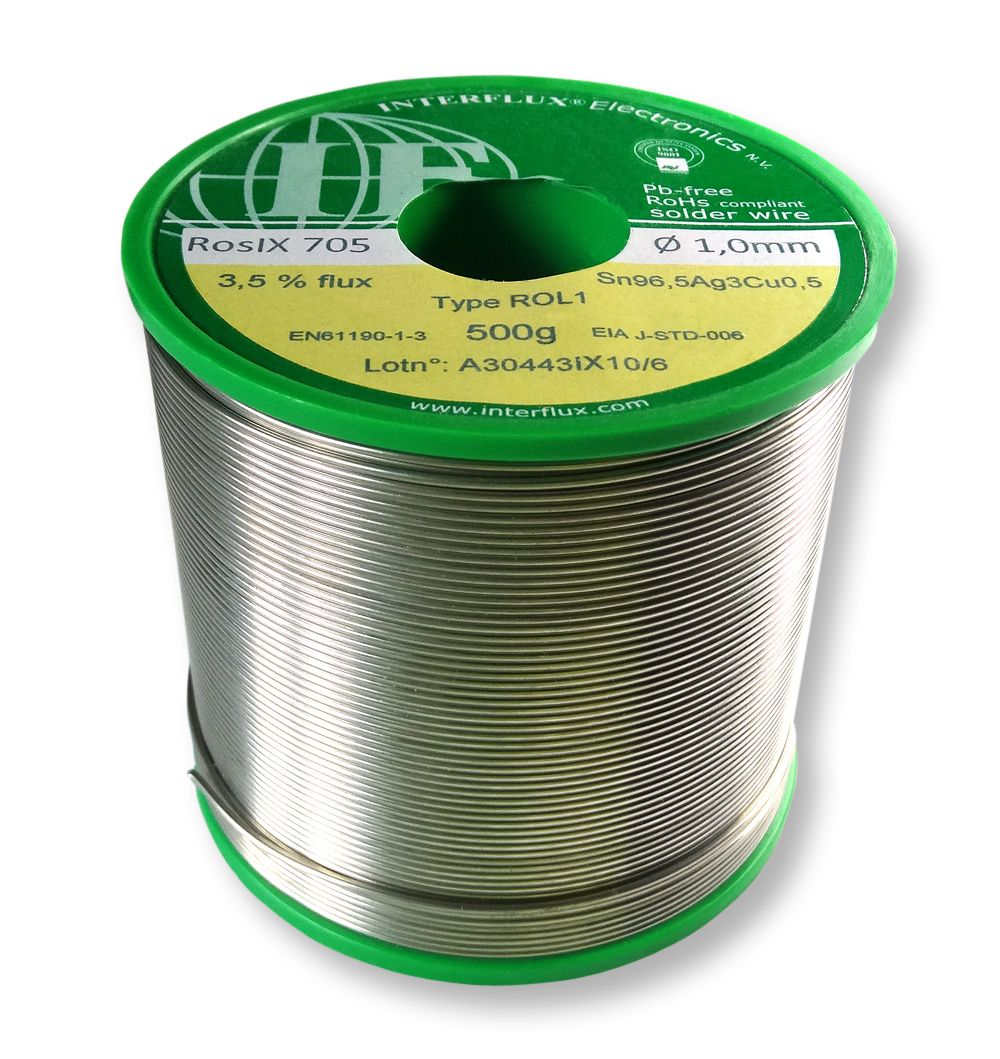
Interflux solder wire IR 3, Sn96.5Ag3Cu0.5, flux content 3.0%, ROL0, diameter 1.0 mm, on 500 g spool
The perfect wire for your soldering robot
– Very well suited for laser soldering and robotic soldering
– Extremely low spatter
– Fast wetting
– Completely halogen-free
Interflux® IR 3 is a halogen-free and lead-free no-clean solder wire developed for automatic soldering applications. The wire has very low spatter and fast wetting on common surfaces.
Typical applications for IR 3 are laser soldering and robotic soldering. However, the wire also works very well for normal manual soldering.
Flux spatter is a typical phenomenon with lead-free solder wires. IR 3 has been specially developed to solve this problem.
IR 3 is completely halogen-free and is classified as ROL0 according to IPC and EN standards.
Manual soldering and robotic soldering
– Recommended working temperature: 320°C – 390°C. For metals with higher density such as nickel: up to 420°C.
A good soldering iron is important. Use a soldering station with a short control time and sufficient power for the application. Choose the right soldering tip so that the contact area with the parts to be soldered is large and the thermal resistance is reduced. Heat the surfaces to be soldered at the same time. Briefly apply the solder wire to the interface between the soldering iron and the surfaces to be soldered. The liquid solder will accelerate heat transfer. Apply the correct amount of solder wire without interruption near the soldering tip.
Avoid direct contact between the solder wire and the soldering tip to prevent flux splashes and excessive flux consumption.
Laser soldering
When laser soldering, the focus is often on optimizing the soldering time. In most cases, a profile is created in three stages: preheating, soldering, and holding time. The capacity of the laser and the time can be set for this purpose. These settings depend on the thermal mass of the parts to be soldered and are often based on practical experience. It is recommended to have a preheating temperature of at least 300°C before feeding in the solder wire. The amount of solder wire fed in depends on the volume of the solder joint.